May 2026 Highlights and Hot Topics
The May 2026 issue of Highlights and Hot Topics includes a letter from NCCDD’s executive director, emergency preparedness resources for hurricane season, a public policy update, a thank you to NCCDD's outgoing Council members, a new storytelling initiative announcement, and upcoming NCCDD webinars.
- Letter from the Executive Director
- Hurricane Season is Here – Now is the Time to Be Prepared!
- Public Policy Updates (as of 5/15/26)
- Thank You to Our Outgoing Council Members!
- NCCDD Introduces Storytelling Initiative Led by Self-Advocates
- Upcoming NCCDD Webinars in June
- Boletín en español
- Newsletter in Accessible Audio
Letter from the Executive Director
 Let’s build on the momentum of the 2026 I/DD Caucus!
We had twenty-six legislators, over 200 people, and 15 heartfelt presentations from people with intellectual and developmental disabilities (I/DD) and family members. Now, we need to build on that day to ensure action on Medicaid, the waiting list, and the direct care workforce.
What a day!
It started with a welcome event that featured The L’Arche North Carolina Jam Together group singing Lean on Me, and Chris Hendricks, NCCDD’s Policy Education Coordinator/Legislative Liaison, singing two of his songs. We heard heartfelt speeches from Rep. Zack Hawkins, Rep. Sarah Crawford, and Assistant Secretary Kelly Crosbie. Then, self-advocate Michael Wayne O’Neill gave a motivational speech that got us walk’n and roll’n to the General Assembly.
Next up, we had 10 legislators join an informal discussion on critical issues impacting our community, with over 50 individuals and families in a room that was overflowing with energy.
That led to the big event. A standing-room-only crowd of individuals and families heard presentations from individuals with I/DD and family members from Wilmington to the mountains who came to share their stories.
A bipartisan group of legislators – Republicans and Democrats from the Senate and the House – listened and also shared their connections to the I/DD community. Relationships were built and strengthened. Many called it the most important event of the year at the General Assembly. The event sparked a lot of media.
The next day, Representative Sarah Crawford spoke of the event in front of the Governor and a bipartisan group of legislative leaders at the Governor’s Mansion when the Governor signed 2026 Medicaid funding into law.
Now what?
First, send thank-yous to legislators. You can find a list of all 26 legislators here. Second, find ways to build deeper relationships with your legislators. Remind them of the three most critical issues – Medicaid, the waiting list, and the Direct Support Professional workforce. Third, fill out our survey about the event. And finally, let’s continue to work hard together to build on the momentum!
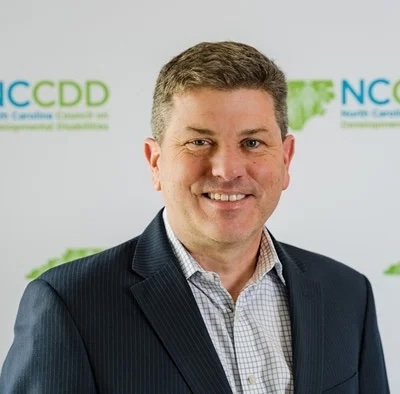
Talley Wells, NCCDD Executive Director
Hurricane Season is Here – Now is the Time to Be Prepared!
The North Carolina Council on Developmental Disabilities (NCCDD) is deeply aware that many North Carolinians are still dealing with significant stress responses and trauma from the 2024 devastation from Hurricane Helene. We truly support our community members who continue to process all that you endured and are still facing. Even with our collective experience, we cannot let down our guard. We encourage everyone across the state to use the information and resources provided by NCCDD. You may even connect with friends and neighbors and encourage them to also prepare themselves.
The Council provides information and resources on its Emergency Preparedness Resources webpage to help people with intellectual and developmental disabilities (I/DD), families, caregivers, and advocates prepare for emergencies and natural disasters. Resources include:
- Information on creating emergency plans and kits,
- Finding shelters,
- Accessing communication tools,
- Locating crisis supports, and
- Applying for financial assistance after disasters.
The page also provides important hotline phone numbers, links to accessible emergency resources, and updates during disaster response efforts in North Carolina.
Don’t delay. Be prepared today!
Public Policy Update (as of May 15, 2026)
FEDERAL
Current Fiscal Year Budget
On April 30, 2026, the House voted to pass a Senate-passed bill that funds non-immigration enforcement agencies in the Department of Homeland Security (DHS), ending the longest recorded shutdown of a single federal agency in U.S. history. This bill includes funding for agencies such as the Transportation Security Administration (TSA) and the Federal Emergency Management Agency (FEMA).
Reconciliation 2.0
The DHS bill described above did not include funding for immigration enforcement agencies. Congressional Republicans are moving forward on a budget reconciliation bill to fund these agencies in DHS.
A reminder that the reconciliation process is what was used to pass HR1 (One Big Beautiful Bill), which included significant Medicaid cuts. Reconciliation is a special legislative tool that can be used by the Senate for mandatory spending and requires only 51 votes instead of 60.
Lawmakers are drafting a narrow reconciliation bill focused on roughly $70 billion in additional funding for Immigration and Customs Enforcement (ICE) and Customs and Border Protection (CBP), targeting a May 15, 2026 committee reporting deadline. Four committees—House Judiciary, House Homeland Security, Senate Judiciary, and Senate Homeland Security & Governmental Affairs—were directed to draft legislation. The Senate Judiciary Committee and the Senate Homeland Security Committee released legislative text for the $72 billion budget reconciliation to fund ICE and CBP through 2029.
The committees plan on holding a review and vote on their portions of the bill—a process known as “markup”—the week of May 19th, before combining the sections into one legislative package for a full vote on the Senate floor. The bill would then move to the House for consideration. Congressional republicans are aiming to enact a final reconciliation bill by June 1, 2026.
So far, the main focus has been on funding ICE and CBP, but there are some lawmakers who have been pushing to include other provisions.
Budget
The regular budgeting/appropriations process for fiscal year 2027 (October 2026 – September 2027) is underway. The process began with the President’s budget, which was released in April, before moving to committees. In the April edition of Highlights & Hot Topics, we provided an overview of the President’s budget, which included an increase in defense spending, along with significant decreases in other spending. The decreases included proposed cuts to disability programs. University Centers for Excellence in Developmental Disabilities (UCEDDs) would be eliminated. The Leadership Education in Neurodevelopmental Disabilities (LEND) Programs would be decreased by almost $20 million. State DD Councils and Protection and Advocacy agencies are proposed to receive only a small decrease. Like last year, there was also a proposed restructuring plan for U.S. Department of Health and Human Services (DHHS), which would eliminate the Administration for Community Living.
The President’s budget is not legislation, but it is required to be submitted each year. It provides insight into the Administration’s priorities. Last year, Congress rejected these cuts and also rejected the restructuring plan for DHHS.
The next steps in the budget process are committee meetings that include administration agency leaders who will talk about the President's budget. These are underway and will continue through May. This will lead to bills being drafted that will include appropriations for different federal departments and programs.
Congress will also hold markups, which is when they meet to work on bills and make updates and changes. Markups for DHHS are scheduled for early June. DHHS includes funding for several disability programs. The goal is to complete all appropriations bills by June 30th and pass the bills before the August recess.
Center for Medicare & Medicaid Services
The Center for Medicare & Medicaid Services (CMS) continues to focus on alleged fraud within Medicaid.
Dr. Mehmet Oz, CMS Administrator, has announced his plan to crack down on alleged Medicaid fraud across the country. Letters have been sent to each state’s governor requiring states to provide plans for how they will double-check that Medicaid providers are not defrauding the program.
On April 30th, it was announced that CMS would withhold $91 million in federal Medicaid funding to Minnesota. CMS expressed concern that “$76 million was tied to 14 service categories highly vulnerable to fraud” and asked Minnesota for more information before doling out the funding.
The concern is that the focus includes Home and Community Based Services, with a target on family as caregivers.
Supplemental Security Income
The Trump administration has advanced a proposed rule change to Supplemental Security Income (SSI) that would penalize adults with disabilities who live with relatives, slashing benefits by up to a third or ending them entirely for an estimated 400,000 low-income recipients. The rule would reclassify "in-kind" support by treating rent, housing, and in-home assistance provided by family members as income. It specifically targets SSI recipients whose families also receive Supplemental Nutrition Assistance Program (SNAP) food stamps.
Advocates warn that penalizing families for housing relatives with disabilities could force individuals out of stable homes and into much more expensive institutional care.
STATE
Legislative
The NC General Assembly convened on April 21st for a short legislative session. The short session is typically focused on making minor budget adjustments and passing a small number of bills.
Session Law 2026-1 was already passed to address some urgent issues. The bill makes several changes to Medicaid and includes other budget items. Two sections are of particular interest to people with intellectual and developmental disabilities (I/DD).
The bill includes $319 million to address the Medicaid shortfall for the current year. These are non-recurring dollars, so this will need to be addressed as the legislature continues to work on a budget.
The bill also included a section addressing the increase in Medicaid costs related to Research Based – Behavioral Health Treatment (RB-BHT). It requires changes to the Clinical Coverage Policy 8F as it pertains to Applied Behavioral Analysis (ABA). Changes include:
- Limits to the use of telehealth.
- Requires assessments to be in-person.
- Requires more oversight by a licensed professional.
- Requires paraprofessionals to be certified.
- Plans over 16 hours a week require special approval.
- Requires professionals to be in-state Medicaid providers.
The Department of Health Benefits (DHB) had already begun to make changes to RB-BHT policy and has tweaked it based on the legislation. The policy should be posted at this time.
Addressing the Budget
North Carolina has not had a budget in place this year since the legislature failed to pass a budget during the previous long session. On May 12th, Senate President Pro Tempore Phil Berger and House Speaker Destin Hall announced they had come to an agreement on some key issues that will allow the budget process to move forward. The agreements included issues related to taxes and raises for teachers, state employees, and law enforcement officers. A significant amount of work remains, but Sen. Berger expressed hope that a budget could be passed in late June.
Legislative Bills
There are a few bills that have been introduced that address the waiting list.
- SB 873 – Innovations Waiver Tiers: Instructs DHHS to work with LME/MCOs; and creates a tiered Innovations waiver ($25,000, $75,000; and full waiver).
- HB 1076 – Innovations Waitlist Reduction Act: This bill proposed to increase waiver slots by 6,635 by revising the eligibility for the Opportunity Scholarships.
- HB 1147 – IDD Omnibus: This is the comprehensive bill that Rep. Hawkins has filed over the last couple of years. It addresses several areas, including DSP wage increases, housing, transportation, and schools. It also includes a section that calls for the development of a 10-year state plan to address the waiting list.
These bills will continue to be discussed in committees. Advocates have expressed some concerns about the specific amounts suggested in the tiered approach. NCCDD has advocated for a comprehensive plan that begins with examining the waitlist before developing a specific solution. Nonetheless, it is good to see the attention to the waitlist by various members of the general assembly.
Department of Health Benefits
The Department of Benefits (DHB) is working on changes to policy for the Innovations Waiver. Changes are being proposed to align with previous legislation related to workforce efforts. The job requirements for some staff positions (Qualified Professional/QP) are being changed from bachelor's level to associate's degrees.
DHB is also working on several areas related to 1915(i). The dashboard for 1915(i) is being finalized and will include more precise data on time frames from referral to assessment to the beginning of services. The assessment tool is being updated, and a guide on completing the assessment is being developed for care managers.
Thank You to Our Outgoing Council Members!
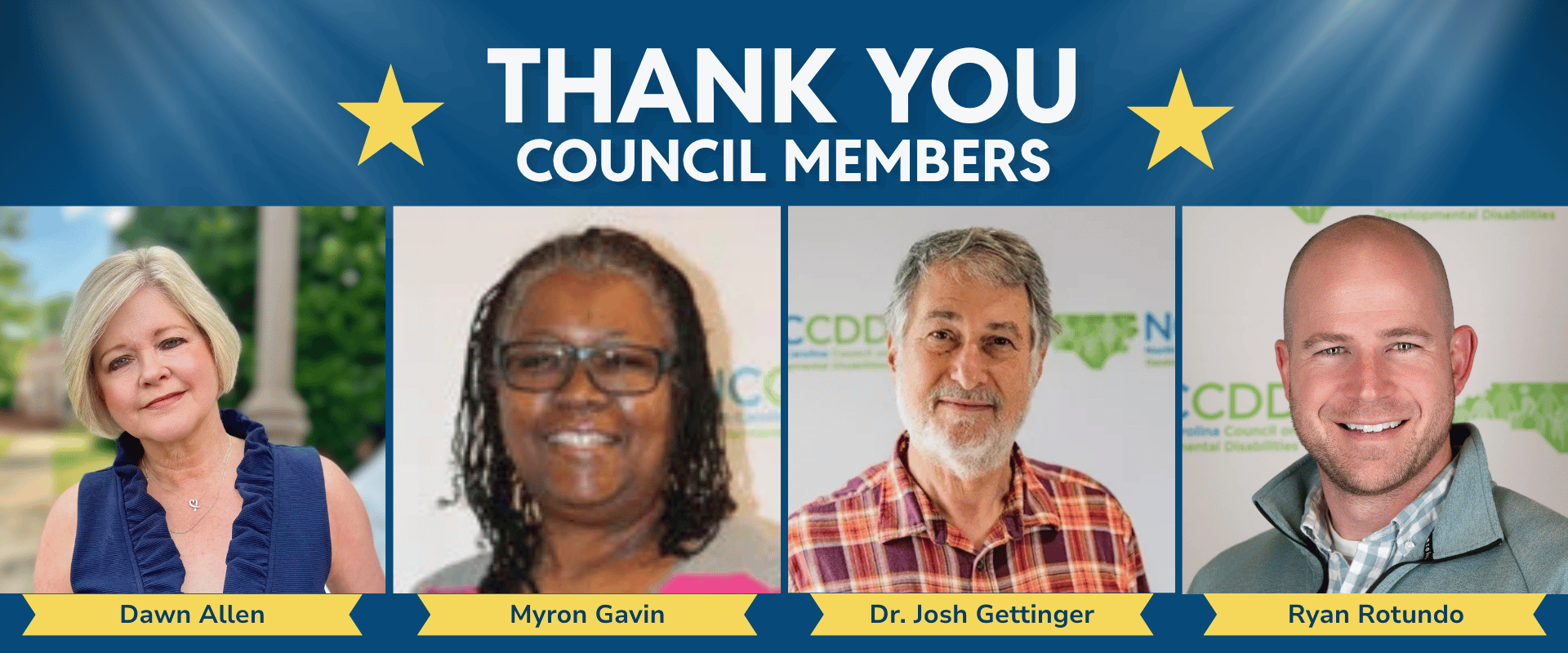
The North Carolina Council on Developmental Disabilities (NCCDD) is proud to have worked with Council members Ryan Rotundo, Myron Gavin, Dawn Allen, and Dr. Josh Gettinger. As they complete their terms and roll off the Council, we know that their work on behalf of people with intellectual or other developmental disabilities (I/DD) will never stop.
NCCDD thanks each member for all they’ve done and will continue to do for North Carolina’s I/DD Community!
Interested in becoming a Council member? Learn more and apply here: https://nccdd.org/about/council-members#apply
NCCDD Introduces Storytelling Initiative Led by Self-Advocates
The North Carolina Council on Developmental Disabilities (NCCDD) is launching a public awareness storytelling initiative called the Community Reporter Program. The program features individuals with developmental or intellectual disabilities (I/DD) from across North Carolina who will serve as local reporters. They will gather and share news and personal stories that show how community issues, policies, and programs affect people with I/DD.
Community Reporters identify local issues, interview people directly affected, and share what they learn to help others across the state understand those issues, different perspectives, and community-driven solutions. Then they choose how to share those stories, such as blog posts, audio or video interviews, graphic art, and infographics. Their stories will be shared on NCCDD’s website, newsletters, and social media.
NCCDD’s first community reporter is Cynthia Harris from Durham. She’ll be reporting on housing challenges for people with disabilities and exploring the positive and negative effects of gentrification on the community. To capture a wide range of perspectives, Cynthia will be interviewing city leaders, professionals working in accessible housing, and individuals with disabilities living in various situations.
Upcoming NCCDD Webinars in June
The North Carolina Council on Developmental Disabilities (NCCDD) offers several monthly webinars to help you stay educated and informed. All meetings are free and open to the public. Stay informed and become involved in important conversations – there’s something for everyone in the I/DD community!
Policy Education Meeting
Thursday, June 11, 2026, from 10:30 AM to Noon
Learn about important updates about state and federal policies, budget developments, and other issues that affect people with intellectual and developmental disabilities (I/DD). There will also be time for questions and open discussion. Please note that NCCDD only provides public policy education. The Council does not lobby on specific legislation.
Register here: https://www.zoomgov.com/meeting/register/vJItdu-uqD8oHpxzFX9FiES_lSmk_8OP4r4#/registration
Self-Advocate Discussion Series
Topic: Voting Rights
Wednesday, June 17, 2026, from 1 - 2 PM
In this session, you will learn about your voting rights and how to make a plan to vote. We will hear from Kenya Meyers, who is the Voting Rights Project Manager at Disability Rights North Carolina. She will share helpful information, resources, and advocacy tips. There will also be time for you to share your thoughts. What would make voting easier for you? What support do you need to be ready to vote the way you want? Join us to talk about voting for people with intellectual and developmental disabilities (I/DD) in North Carolina. Bring your questions and your own voting experiences to share.
Note: Please register at least one week before the session.
To register: https://www.zoomgov.com/meeting/register/GwJ-kZReQ7G4Joz9GYr_6g#/registration
Learn more about his webinar series: https://nccdd.org/get-involved/self-advocate-discussion-series
The Council Presents
Topic: Plain Language
Thursday, June 25, 2026, from 1 - 2 PM
Plain Language is “clear, straightforward, and only uses words necessary to make sure all people can understand and participate.” This definition is from the Association for University Centers on Disabilities (AUCD). Join us for the June session of “The Council Presents” to learn more about Plain Language. We will talk about how to write and speak using Plain Language, why it is helpful, and more. The discussion will include Liz Weintraub, who works for AUCD as Senior Advisory Specialist. Liz has taught many of us how to advocate and use Plain Language in our policy and advocacy work. Her podcast “Tuesdays with Liz” uses Plain Language discussion of important policy topics every week.
To register: https://www.zoomgov.com/meeting/register/JTEBPG47SW2g2Z9fVyH0PQ#/registration
Learn more about this webinar series: https://nccdd.org/get-involved/nc-council-presents
Boletín en español
Lea el boletín aquí: Aspectos destacados & temas de mayo de 2026
Newsletter in Accessible Audio
Listen to the audio version: https://www.buzzsprout.com/2526321/episodes/19204616