June 2026 Highlights and Hot Topics
The June 2026 issue of Highlights and Hot Topics includes a letter from NCCDD’s executive director, an Advocacy and Leadership Awards announcement about nominations, a public policy update, an update on federal special education oversight, and upcoming NCCDD webinars.
- Letter from the Executive Director
- Nominations Open for NCCDD's Advocacy & Leadership Awards!
- Public Policy Updates (as of 6/24/26)
- Families and Advocates Concerned About Federal Special Education Oversight Changes
- Upcoming NCCDD Webinars in July
- Boletín en español
- Newsletter in Accessible Audio
Letter from the Executive Director
 This summer, we celebrate three critical anniversaries for our country and for the disability rights movement.
July 4th is the 250th anniversary of our country. We celebrate our nation’s creed, which we have not fully lived out but which we continue to strive toward. It is our Declaration of Independence.
It was the moral anchor of Lincoln’s Gettysburg Address. We all have a right to life and liberty.
It was sung out to the thousands by Dr. King, “One day this nation will live out the true meaning of its creed: We hold these truths to be self-evident …” We are all created equally. We all have the right to the pursuit of happiness.
July 26th will be the 36th anniversary of when President George H.W. Bush signed into law our disability rights declaration of independence – the Americans with Disabilities Act. The very first words of the ADA declare: “The Congress finds that- physical or mental disabilities in no way diminish a person's right to fully participate in all aspects of society.” Yet, Congress declared, “the continuing existence of unfair and unnecessary discrimination and prejudice denies people with disabilities the opportunity to compete on an equal basis and to pursue those opportunities for which our free society is justifiably famous . . .” (Source: 42 U.S.C. 12101(a) 1, 8)
June 22nd was the 27th anniversary of the Olmstead decision. In that decision, Justice Ruth Bader Ginsberg and a majority of the United States Supreme Court ruled that people with disabilities have the right to live fully in the community rather than in institutions. She found that confining people in institutions discriminated against them, it diminished their “everyday life activities” and created a perception that they were “incapable or unworthy of participating in community life.” In other words, she said people with disabilities are just as worthy, just as deserving of living out our nation’s creed. We are all created equally and have the right to life, liberty, and the pursuit of happiness.
So, this summer let’s celebrate our nation’s creed through our Independence Day, the Olmstead Anniversary, and the anniversary of the Americans with Disabilities Act.
Talley Wells, NCCDD Executive Director
*Note: Right after I drafted the above article, the United States Justice Department (DOJ) issued an opinion stating that it was substantially limiting its interpretation of Olmstead. This opinion is not a court decision and should not be interpreted as one, but the Justice Department has several critical responsibilities related to Olmstead. While the DOJ opinion is very concerning, the anniversaries of the ADA, Olmstead, and our country each remind us that independence and liberty often face obstacles, and we have repeatedly found ways to overcome those obstacles. We will continue to do so.
Nominations Open for NCCDD's Advocacy & Leadership Awards!
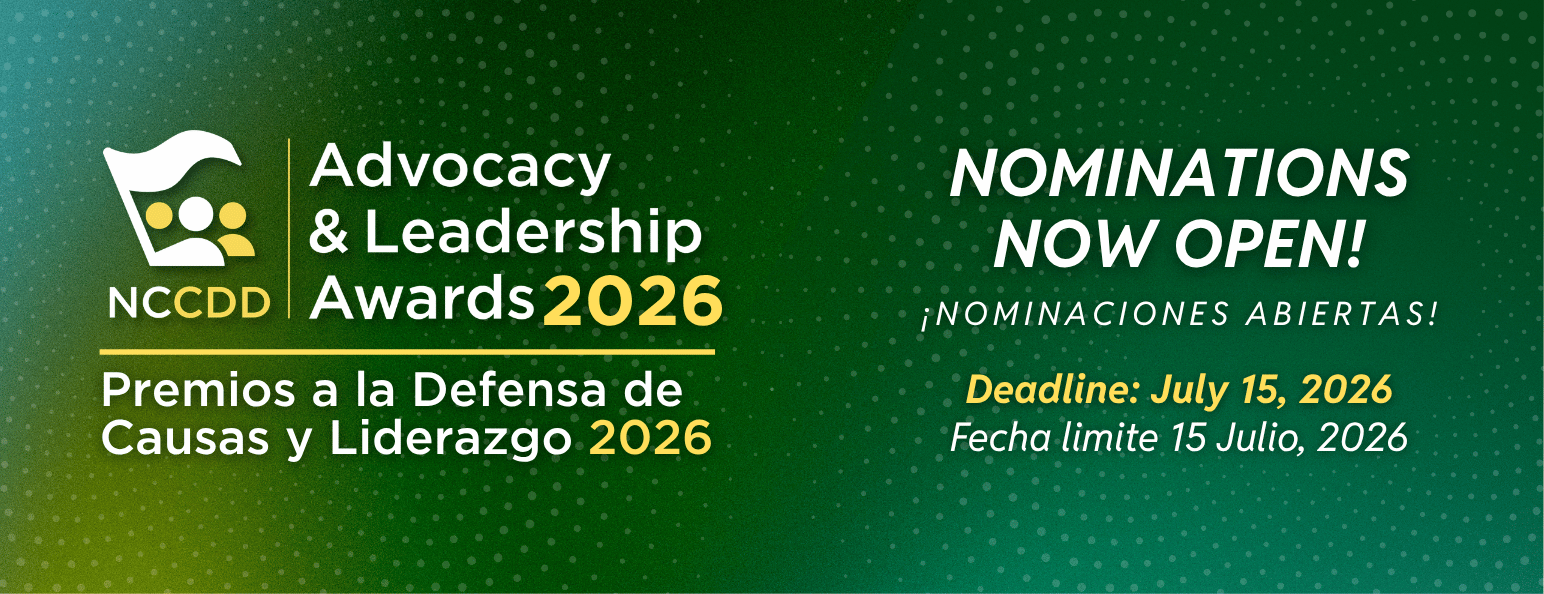
Do you know someone changing lives in North Carolina's intellectual or developmental disabilities (I/DD) community? The North Carolina Council on Developmental Disabilities (NCCDD) is accepting nominations for its 2026 Advocacy and Leadership Awards!
These annual honors shine a spotlight on advocates who are breaking barriers, expanding choices, and helping to build a more inclusive North Carolina for people with I/DD. You can nominate someone—or yourself—now through July 15, 2026, for one of the following categories:
- The North Carolina Leadership Achievement Award: Recognizes an outstanding North Carolina self-advocate whose work has improved the quality of life for people with I/DD.
- Jack B. Hefner Memorial Award: Recognizes the vision and achievements of North Carolina's families and people with I/DD.
- Helen C. “Holly” Riddle Distinguished Service Award: Recognizes the vision and achievements of professionals within North Carolina's I/DD community.
Deadline for nominations is July 15, 2026.
Learn more and submit your nominations
Meet Last Year's Awards Recipients
The 2025 Advocacy & Leadership Awards were presented to:
- Laura Newell - North Carolina Leadership Achievement Award
- Ray Hemachandra - Jack B. Hefner Memorial Award
- Pat Kuel - Helen C. "Holly" Riddle Distinguished Service Award
In addition, the Kerri Eaker Mountain Mover Award was presented to Lauren Howard and LaDonna Huffaker. Recipients of this award are chosen by the Council.
Watch NCCDD's video series on YouTube to learn more about last year's awardees and the positive impact they've made for North Carolina's I/DD community!
Frequently Asked Questions
Can I nominate myself?
Yes! We encourage individuals to self-nominate for an award.
What do you look for in nominees to be award winners?
Those making nominations must show that the person they are nominating is making an impact in their local community that benefits others with I/DD.
How are the recipients selected?
A selection committee of NCCDD members reviews all applications and carefully considers all information submitted about the candidates. Then they choose a candidate to receive each award.
What do the recipients get?
The winners are invited to the November Council meeting and can invite up to four guests to the awards ceremony. The award winners will receive a plaque, an opportunity to address the Council, and their story will be promoted on the Council website, social media pages, and in their hometown newspapers.
Public Policy Update (as of June 24, 2026)
FEDERAL
Reconciliation
Reconciliation process is what was used to pass HR1 (One Big Beautiful Bill), which included significant Medicaid cuts. Reconciliation is a special legislative tool that can be used by the Senate for mandatory spending and only requires 51 votes instead of 60.
Reconciliation 2.0 passed out of Congress and was signed by the President on June 10, 2026. The bill includes nearly $70 million to fund Immigration and Customs Enforcement (ICE) and Border Patrol through 2029.
Following the 2.0 package, House Republicans and the White House are in discussions for a third reconciliation bill. Reconciliation 3.0 will likely focus on defense spending, entitlement reforms (Medicaid, Medicare, health savings accounts), anti-fraud measures, and SAVE Act (Safeguard American Voter Eligibility Act), which would require Americans to provide documentary proof of U.S. citizenship, such as a passport or birth certificate, to register to vote in federal elections. While this seems to be moving in the House, the Senate does not appear to be eager to take this on.
Budget
The regular budgeting/appropriations process for fiscal year 2027 (October 2026 – September 2027) is continuing. Most activity has been on the House side. All committee markups and approvals have been completed. The Committee that NCCDD follows the closest is Labor, Health and Human Services and Education.
We are relieved to see several specific areas related to intellectual or other developmental disabilities (I/DD) maintain flat funding in this bill:
- Developmental Disabilities State Councils
- Protection & Advocacy (P&A)
- Voting Access for Individuals with Disabilities
- UCEDDs – University Centers for Excellence
- Independent Living Programs
- Assistive Technology Act Programs
- Traumatic Brain Injury (TBI) Programs
- NIDILRR – Disability & Rehabilitation Research
But there are other areas that affect people with disabilities:
- Affordable Care Act (ACA) Marketplace: $1 billion cut (reduce access to health care).
- Department of Labor: $3.7 billion cut includes cuts to re-entry programs (people with disabilities have benefited from these programs) and cuts to the Workforce Innovation and Opportunity Act (WIOA).
- Department of Education: $8.1 billion cut includes cuts to Title 1(support for low-income schools), cuts to Federal Work-Study programs, and cuts to the Office of Civil Rights (protections for students with disabilities).
- Blocks funding for any policies that promote diversity, equity, and inclusion.
- There were some slight increases to IDEA and Head Start, but these come at the expense of other programs like after-school programs and professional development.
The above are proposed budgets from the House committees. All committee appropriations bills have to be passed on the House floor. At this writing, two have passed, and the rest of the twelve await floor votes. They are all expected to pass.
The Senate has not made as much progress on its budget bills. There seems to be a stalemate with no agreement on the top number for the entire budget. It is very unlikely that they will complete markups on their committee appropriations bills by the August recess. Due to election-year legislative calendars and disagreements over top-line numbers, Congress will likely need to pass one or more Continuing Resolutions (CR) to prevent a shutdown when the fiscal year begins in October.
HR 8464: Stopping Fraudulent Payments Act
The House voted to pass H.R. 8464: Stopping Fraudulent Payments Act on June 10, 2026, as part of a broader package of 11 oversight bills aimed at cutting down on government waste and fraudulent federal assistance.
This bill is designed to let federal agencies stop suspicious disbursements (such as Medicare or state-administered federal programs like Medicaid and SNAP) before the money leaves the Treasury, rather than attempting to get it back after the fact. Advocates are concerned because it creates a broad and subjective authority allowing federal agencies or the Secretary of the Treasury to block federal payments to individuals, nonprofit organizations, communities, and states. While the bill suggests this authority is narrowly related to preventing fraud, its language is broad and vague enough for this, or any other, administration to stop, delay, or condition payments for programs or states it disfavors.
The bill is now being transmitted to the Senate, where it must be assigned to a committee, debated, and voted on before it can head to the President's desk to become law.
Work Requirements
North Carolina and other states have been working on implementing the new work requirement from HR1. On June 1, 2026, the Centers for Medicare and Medicaid Services (CMS) released an interim final rule that details how states should manage exemptions for work requirements for adults ages 19-64 created under H.R.1. The rule clarifies who is exempt from these work requirements and what Medicaid beneficiaries would have to do to qualify for an exemption. According to the new rule, in order to prove you are “medically frail”— a definition that is not typically used in the disability community — you have to also show that your condition significantly impairs your ability to meet work requirements.
For 2027, CMS will allow beneficiaries to self-declare that they meet those exemptions. Starting in 2028, people will need to show documentation and proof to keep their benefits, and many people may lose coverage simply because they cannot get a doctor's statement to prove they need the exemption or they make an administrative mistake in submitting their documentation. This rule will mean that more people will lose access to the healthcare that they need due to the heightened administrative burden.
Many states have been preparing for the implementation of H.R.1 by using their own diagnostic codes to identify people who can claim a medically frail exemption. Now, they will have to adopt this new, more restrictive definition of medical frailty, and they are not allowed to add more categories to the list of people who can claim that exemption.
Olmstead
In 1999, the Supreme Court in Olmstead vs LC recognized that people with disabilities have a ‘right to live in the world’ and states have an obligation to provide services in the community that promote integration. This ruling is the foundation of disability rights and so integral to the inclusion of people with I/DD in their communities.
A recent opinion issued by the Department of Justice says that federal law does not explicitly require states to provide community-based care for people with disabilities. The memo asserts that neither Title II of the Americans with Disabilities Act nor Section 504 of the Rehabilitation Act contains a strict "integration mandate" that forces states to serve people in community-based settings instead of institutions. This interpretation goes against current federal integration policy and signals a shift in enforcement regarding the Olmstead mandate.
This opinion is not the same as a court decision; it does not take away the Olmstead ruling or ADA or Section 504. But it is alarming that the federal government may not enforce these laws. The Arc put it this way, “This opinion seeks to undermine one of the strongest protections people with disabilities have from being pushed into institutions when they can and want to live in the community.”
The American Association of People with Disabilities and The Arc of the United States condemned the memo, warning that it encourages states to defund home-based services and push vulnerable individuals into institutional care.
Here is a link to a statement from The Arc: https://thearc.org/blog/doj-opinion-on-olmstead-threatens-the-right-of-people-with-disabilities-to-live-in-the-community/
Department of Education
Over a year ago, President Donald Trump announced that he would move “special needs” programs to HHS as part of a commitment to close the Education Department. We are beginning to see how this may be accomplished. See the article about the Office of Civil Rights and other grants being moved out of the Department of Education.
STATE
Legislative
Addressing the Budget – North Carolina has not had a budget in place this year as the legislature failed to pass a budget during the previous long session. And this is the main objective during this short session – to approve a budget. We heard back in May that Senate President Pro Tempore Phil Berger and House Speaker Destin Hall had come to an agreement on some key issues that will allow the budget process to move forward. The agreements included issues related to taxes and raises for teachers, state employees, and law enforcement officers. Work on the budget has continued since that time.
On June 17th, House Speaker Destin Hall and Senate Leader Phil Berger met to talk about the budget, indicating that they are close to coming to an agreement. Both expressed that they are hopeful that a budget could be passed by the end of June.
Legislative Bills
HB 34 – Strengthen Medicaid Provider Controls
This bill provides DHHS with the authority to deny or terminate Medicaid providers based on certain actions on a provider’s licensing board and clarifies the Department’s authority to deny or terminate Medicaid providers because of criminal convictions and other activity. This bill also requires that health plans have closed networks for Research-Based Behavioral Health Treatment (RB-BHT), peer support, and community support teams.
The intent of this bill is to ensure quality providers of Medicaid services in the state. There has been considerable concern and feedback from provider organizations about the vagueness of certain provisions and the scope of others. Meetings between provider representatives and legislators have led to some adjustments to language and clarification of some sections. The bill has passed the House and is awaiting passage in the Senate.
Families and Advocates Concerned About Federal Special Education Oversight Changes
The U.S. Department of Education recently announced that some of its responsibilities will move to other federal agencies. Oversight of special education programs, transition services, and vocational rehabilitation will move to the U.S. Department of Health and Human Services. Responsibility for investigating disability-related education civil rights complaints will move to the U.S. Department of Justice.
Students with disabilities have the right to a free appropriate public education (FAPE) under the Individuals with Disabilities Education Act (IDEA). For decades, the U.S. Department of Education has been responsible for helping ensure schools follow these protections.
Wisconsin’s DD Council – Wisconsin Board for People with Developmental Disabilities (BPDD) – shared its statement and resources with other state DD Councils on the potential impact and concerns that these changes might cause.
BPDD Executive Director Jenny Price said families, educators, and states benefit from having one agency focused on helping students with disabilities succeed. She expressed concern that moving these responsibilities to agencies with broader missions could make support and oversight more difficult.
Also, last year, the U.S. Department of Education reduced staffing in its Office for Civil Rights, including staff who investigate complaints from families about schools. About half of those complaints involve special education. BPDD Board Chair Sydney Badeau said splitting special education responsibilities across multiple agencies may make it harder for families to know where to go for help when a student’s rights are not being met.
You can read BPDD’s statement here. NCCDD will continue to monitor the changes and provide updates.
Upcoming NCCDD Webinars in July
The North Carolina Council on Developmental Disabilities (NCCDD) offers several monthly webinars to help you stay educated and informed. All meetings are free and open to the public. Stay informed and become involved in important conversations – there’s something for everyone in the I/DD community!
Policy Education Meeting
Thursday, July 9, 2026, from 10:30 AM to Noon
Learn about important updates about state and federal policies, budget developments, and other issues that affect people with intellectual and developmental disabilities (I/DD). There will also be time for questions and open discussion. Please note that NCCDD only provides public policy education. The Council does not lobby on specific legislation.
Register here: https://www.zoomgov.com/meeting/register/vJItdu-uqD8oHpxzFX9FiES_lSmk_8OP4r4#/registration
Self-Advocate Discussion Series
Topic: Celebrate the 36th Anniversary of the Americans with Disabilities Act
Wednesday, July 15, 2026, from 1 - 2 PM
The Americans with Disabilities Act (ADA) was signed into law on July 26, 1990, by President George H.W. Bush. Throughout the year and on the ADA Anniversary (July 26), the ADA National Network recognizes this landmark event and the important work to promote equal opportunity for people with disabilities. Join us to celebrate, share, and learn.
Note: Please register at least one week before the session.
To register: https://www.zoomgov.com/meeting/register/GwJ-kZReQ7G4Joz9GYr_6g#/registration
Learn more about his webinar series: https://nccdd.org/get-involved/self-advocate-discussion-series
The Council Presents
Topic: ADA 36th Anniversary
Thursday, July 23, 2026, from 1 - 2 PM
July 26, 2026 will mark the 36th anniversary of the signing of the Americans with Disabilities Act (ADA). The ADA says that employers and places open to the general public must provide reasonable accommodations to people with disabilities. But how does a person with a disability successfully request and secure an accommodation? During this session, hear from people with I/DD and other disabilities who have successfully received accommodations. They will share their lived experience and talk about how they did it to help the next person who might need similar access to a job, a building, a service, or an event.
To register: https://www.zoomgov.com/meeting/register/JTEBPG47SW2g2Z9fVyH0PQ#/registration
Learn more about this webinar series: https://nccdd.org/get-involved/nc-council-presents
Boletín en español
Lea el boletín aquí: Aspectos destacados & temas de junio de 2026
Newsletter in Accessible Audio
Listen to the audio version: https://www.buzzsprout.com/2526321/episodes/19408128