February 2026 Highlights and Hot Topics
The February 2026 issue of Highlights and Hot Topics includes a reflection article from NCCDD’s executive director, a request for public input on the next Five-Year State Plan, a public policy update, an invitation to apply for the next ALP-NC cohort, and upcoming NCCDD webinars.
- Letter from the Executive Director
- Your Voice Needed: NCCDD’s Five-Year Plan Open for Comment
- Public Policy Updates (as of 2/23/26)
- Apply for the Next ALP-NC Leadership Cohort: Apply by Monday, March 2nd
- Upcoming NCCDD Webinars in March
- Boletín en español
- Newsletter in Accessible Audio
Message from the Executive Director
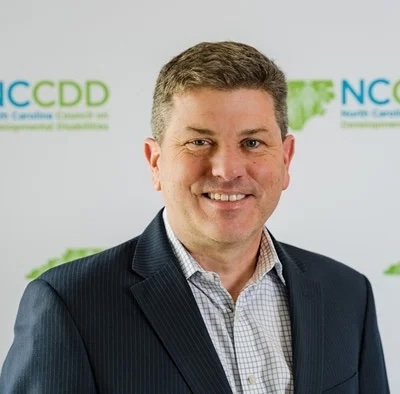
It is already time to start getting ready for the General Assembly to convene in April. April is also the month when Medicaid is expected to run out of money in North Carolina. It is essential that state leaders find a way to make sure that the funding continues.
At the North Carolina Council on Developmental Disabilities, we will once again ask for your stories and your advocacy. We know that individuals and families were harmed in October and November when the state implemented cuts to Medicaid. Fortunately, the pain was temporary because the cuts were rescinded. Still, we do not want to go through that again.
During those two months, we once again learned how critical 1915(i), the Innovations Waiver, CAP-DA, CAP-C (Community Alternatives Programs), and other services are to the intellectual and developmental disabilities (I/DD) community. We will continue to face unprecedented risks to state and federal funding for Medicaid I/DD services this year and in the coming years. We must once again renew our efforts to tell our stories and advocate.
We are tentatively planning to have a day at the legislature for the I/DD community on April 29th. Please mark your calendars in pencil and plan to be there. I say ‘pencil’ because schedules sometimes have to be changed depending on what is happening at the General Assembly, but that is likely the date we will be there. We would love for you to be there with us!
Please also make sure when you have discussions with state leaders at NC DHHS, the Governor’s office, and your local leaders, that they hear your opinion on how important 1915(i), the Innovations Waiver, residential supports, and other services are to North Carolina’s I/DD community. There may be a time when very difficult budget decisions need to be made. Leaders must hear your perspective on how essential I/DD services are to our community.
We also must continue to make progress on strengthening these services. We need to continue to work to ensure everyone’s needs are met who are on the state’s 20,000+ waiting list. And we must work to ensure we have a robust, well-paid, and well-trained Direct Support Professional workforce.
I am really looking forward to working with you to continue our advocacy!
Talley Wells, NCCDD Executive Director
Your Voice Needed: NCCDD’s Five-Year Plan Open for Comment
Beginning on Monday, March 2, 2026, the North Carolina Council on Developmental Disabilities (NCCDD) is accepting public input on the Council's next Five-Year State Plan Goals and Objectives. Your input helps NCCDD ensure its initiatives serve the needs of North Carolina’s intellectual and developmental disabilities (I/DD) community.
Review the Goals and Objectives and provide your input here: https://nccdd.org/about/five-year-state-plan/public-input-for-nccdds-2027-2031-five-year-state-plan
Public comments will be accepted through Thursday, April 16, 2026.
Public Policy Update (as of February 23, 2026)
FEDERAL
Budget
On January 22, 2026, the House passed the remaining six appropriation bills, including Labor, Health and Human Services, and Education, Defense, Transportation and Housing and Urban Development, Financial Services and General Government, State and Foreign Operations, and Homeland Security. This package of six bills was sent to the Senate for their approval. On January 30, 2026, the Senate passed all but Homeland Security, which was removed to allow for additional negotiation in the wake of the shootings by ICE in Minneapolis.
Since the package changed, it was sent back to the House, which passed the package of five bills on February 3, 2026. Below are key parts of the new budget that affect people with disabilities.
Health and Human Services
- Administration for Community Living (ACL): $2.5 billion
- UCEDDs: level funded at $43,119,000
- Health Resources and Services Administration (HRSA): $8.9 billion, an increase of $929 million above FY2025
- LENDs: not specifically cited, but Autism and Other Developmental Disabilities (which includes LENDs) has a $1 million increase to $57,344,000, so we can assume LENDs are level funded
- State Councils on Developmental Disabilities: level funded at $81,000,000
- Protection & Advocacy: level funded at $45,000,000
- National Institutes of Health (NIH): $48,716,000,000, an increase from FY25 and from the President’s budget
- Voting Access for Individuals with Disabilities: $10,000,000
- Center for Medicaid and Medicare Services program management – level funded $3.7 billion
Rejects the Administration's proposal to consolidate the Administration for Children and Families and the Administration for Community Living.
Education
- Individuals with Disabilities Education Act (IDEA) funding was increased by $20,000,000
- Grants to states (Part B): $14,233,704,000
- IDEA Part C: $540,000,000
- Head Start: $12,356,820, an increase of $85 million from 2025
- Transition and Postsecondary Programs for Students with Intellectual Disabilities (TPSIDs): $13,800,000
Bill highlights that Congress has not provided the authority to the Education Department to transfer its responsibilities to other agencies.
Interagency Autism Coordinating Committee (IACC)
The Department of Health and Human Services appointed 21 new members. There is some concern from advocates that many of the new appointees support unproven causes and treatments of autism. In addition, the number of self-advocates on the committee has been reduced from 7 to 3. The Autism Science Foundation released a statement on the new IACC membership in which they say that this new membership “does not reflect the breadth of the autism community” and “disproportionately represents a very small subset of families who believe vaccines cause autism, while excluding the overwhelming majority of autistic individuals, families, and advocates who support evidence-based science.”
Food and Drug Administration (FDA)
The FDA removed a webpage titled “Be Aware of Potentially Dangerous Products and Therapies that Claim to Treat Autism” from its website (link goes to archived page). Previously, the page warned about practices like chelation therapy and hyperbaric oxygen therapy, which are often marketed towards parents and family members of autistic children as potential cures or treatments for autism. The FDA page included quick tips to help people identify false or misleading claims about treatments or products that could potentially cause harm to autistic individuals
Lawsuit Regarding Section 504
On January 23, nine states renewed a lawsuit against Section 504 of the Rehabilitation Act and the integration mandate. Under Section 504, the integration mandate ensures that people with disabilities can receive services in the community instead of institutions. The nine states are challenging a Department of Health and Human Services (HHS) rule about the integration mandate, which says that any entity receiving funding from HHS needs to serve people with disabilities in the most integrated setting appropriate. The nine states say that this rule is unlawful and unconstitutional.
This lawsuit is a revised version of an earlier case, in which 17 states argued that Section 504, as a whole, is unconstitutional. The states later withdrew their claim after advocacy from the disability community. Now, Alaska, Florida, Indiana, Kansas, Louisiana, Missouri, Montana, South Dakota, and Texas are renewing the lawsuit
If successful, it would be harder for disabled people to enforce their right to live and participate in the community.
STATE
Budget
North Carolina is the only state in the U.S. without an enacted budget for the 2025-2027 biennium. State operations continue under previous funding levels. It is not expected that the budget will be addressed until the General Assembly returns for the short session in April 2026.
There are impacts of not having a budget on several areas, including teachers' raises and state employees' raises. The area that has been on advocates' radar is the shortfall in the Medicaid rebase. The Department of Health and Human Services enacted Medicaid rate cuts back in October as a result of the shortfall. The cuts were in response to the General Assembly allocating dollars that are projected to fund Medicaid only through April 2026. Then, during the second week of December, Governor Stein announced that the Medicaid cuts to providers that were put in place on October 1, 2025, were ending. The cuts were reversed following successful legal challenges.
So the shortfall remains, and the responsibility now falls back to the General Assembly to provide a long-term financial solution for Medicaid. Legislative leadership has suggested that they will monitor the Medicaid situation in the time leading up to when they return.
PHP (Prepaid Health Plans) H.R.1 Program Workgroup
A workgroup has been convened, which includes a Division of Health Benefits team and representatives from the Health Plans in North Carolina. The workgroup is developing plans to address the requirements from HR 1, which are designed to reduce Medicaid spending. Some of the first initial areas to be addressed are below.
(Sec. 71109) “Qualified Alien” Medicaid Eligibility. This section has to be enacted by October 1, 2026. Beneficiaries with an immigration status that is no longer eligible will be disenrolled from Medicaid. This will result in loss of funding for previously eligible populations, including most refugees, asylees, victims of human trafficking, abused spouses and children, DACA (Deferred Action for Childhood Arrivals) recipients, individuals whose deportation is being withheld or who were granted conditional entry, and individuals who received humanitarian parole. Hospitals and providers will not be able to receive federal Medicaid reimbursement for care provided to these populations.
There is also a provision that eliminates the higher Medicaid percentage under ACA for emergency care provided to immigrants who would qualify for Medicaid except for their status. These modifications to FMAP payments will likely lead to lower Medicaid payments to states, requiring them to fund more to maintain current reimbursement levels.
(Sec. 71119) Work/Community Engagement Requirements for Expansion Adults. The state is expected to enact this requirement by January 1, 2027. Beneficiaries ages 19-64 receiving coverage through Medicaid expansion must meet work/community engagement requirements or be granted an exception to maintain coverage.
(Sec. 71107) Eligibility Redeterminations for Certain Individuals. This requirement must be in place by January 1, 2027. Most beneficiaries receiving coverage through Medicaid expansion will have eligibility re-evaluated every 6 months (this is currently every 12 months).
(Sec. 71112) Limits on Retroactive Medicaid / CHIP Coverage. This must in place by January 1, 2027. Beneficiaries who apply for Medicaid may only receive up to 1 month (MXP) or 2 months (all other Medicaid) of retroactive coverage. This is a reduction from 3 months.
These federal requirements place additional administrative burden on North Carolina and, along with other cuts to Medicaid, will create a loss of services over the next several years.
Apply for the Next ALP-NC Leadership Cohort: Apply by Monday, March 2nd
The Ability Leadership Program of North Carolina (ALP-NC) is accepting applications for its Cohort 1 - 2026.  This is a peer-led program that empowers advocates within the disability rights community. The cohort provides online educational and professional development training, helping advocates build leadership skills and learn how to advocate together for change. The application deadline is Monday, March 2, 2026, by 5:00 p.m. ET.
Who can apply?
- Adults with an intellectual and/or developmental disability (I/DD)
- People who identify with the lived experience of disability
- Family members or caregivers of persons with lived experience
- In-field professionals supporting people with I/DD
How are meetings held?
This is an online program made up of Group Sessions and Learning Team Meetings. All meetings take place on Zoom and are held every Friday from April 3, 2026 through May 29, 2026.
What will you learn?
In this program, you will learn:
- Different types of advocacy (self, collective, peer and systems),
- Why advocacy and leadership are important for the disability justice movement,
- The steps and skills to use when you advocate, and
- How to develop and share your personal story so you can engage in personal and collective advocacy.
Attendance Expectations
Attendance and active participation are important to being a part of this program. If you are not able to attend all weekly sessions, please wait to apply for a future cohort. The schedule is included on the application, so you can review the dates before applying.
Application Instructions
- Applications are due by 5 p.m. ET on Monday, March 2, 2026.
- Apply by completing this online Google form.
- Remember to click "Submit" when you are finished. You will receive a message letting you know it has been sent.
- If accommodations are needed to apply, please send an email to
This email address is being protected from spambots. You need JavaScript enabled to view it. . - Selections will be announced on Monday, March 9, 2026.
For more information
Visit the Ability Leadership Program website at https://alp-nc.org.
Upcoming NCCDD Webinars in March
The North Carolina Council on Developmental Disabilities (NCCDD) offers several monthly webinars to help you stay educated and informed. All meetings are free and open to the public. Stay informed and become involved in important conversations – there’s something for everyone in the I/DD community!
Policy Education Meeting
Thursday, March 12, 2026, from 10:30 AM to Noon
Learn about important updates about state and federal policies, budget developments, and other issues that affect people with intellectual and developmental disabilities (I/DD). There will also be time for questions and open discussion. Please note that NCCDD only provides public policy education. The Council does not lobby on specific legislation.
Register here: https://www.zoomgov.com/meeting/register/vJItdu-uqD8oHpxzFX9FiES_lSmk_8OP4r4#/registration
Self-Advocate Discussion Series
Wednesday, March 18, 2026, from 1 - 2 PM
Topic: Transportation and Travel for People with Disabilities
What does ideal transportation mean to you as a self-advocate? What do we need more of when it comes to getting around and going where we want to and when we want to go? If you are passionate about improving transportation and traveling for people with disabilities, please join us in March! We will talk about ground, water, and air transportation. And about public, private, accessible, and community-supported transportation systems. Experts will share experiences, insight, and advocacy tips. And as always, we’ll have time to hear from YOU about our experiences!
Note: Please register at least one week before the session.
To register: https://www.zoomgov.com/meeting/register/GwJ-kZReQ7G4Joz9GYr_6g#/registration
Learn more about his webinar series: https://nccdd.org/get-involved/self-advocate-discussion-series
The Council Presents
Thursday, March 26, 2026, from 1 - 2 PM
Topic: Housing Roundtable
Join us for a Housing Roundtable to hear about issues and strategies that will help people with I/DD obtain and maintain housing in a place of their choice in the community. Planned panelists include:
- NCCDD member Carol Conway, a parent who has extensively researched ways that parents of adults with I/DD can leave their home to their adult child after they pass away or are no longer able to care for the child.
- Laura Wells, the Executive Director of HOPE North Carolina, will discuss how HOPE NC is working to create inclusive housing options for adults with I/DD across the state, as well as current HOPE NC inclusive housing communities in the Triangle.
- Suvya Carroll, a person with I/DD, will discuss living with a roommate in a thriving housing community.
To register: https://www.zoomgov.com/meeting/register/JTEBPG47SW2g2Z9fVyH0PQ#/registration
Learn more about this webinar series: https://nccdd.org/get-involved/nc-council-presents
Boletín en español
Lea el boletín aquí: Aspectos destacados & temas de febrero de 2026
Newsletter in Accessible Audio
Listen to the audio version: https://www.buzzsprout.com/2526321/episodes/18740572